INDUSTRIAL AGITATORS

Elite Group Middle East (FZC) supplies and exports high-performance Industrial Agitators for Tanks in the UAE, offering reliable mixing and agitation solutions for industrial processing applications. Industrial agitators are designed to mix, blend, homogenise, suspend, and circulate liquids, chemicals, slurries, and other materials inside storage tanks, process vessels, and industrial containers.

Our range of industrial tank agitators includes Vertical Agitators, Horizontal Agitators, Submersible Agitators, and Tailor-Made Agitators, designed to meet different process requirements, tank configurations, and operating conditions.

Vertical Agitators Suppliers and exporters

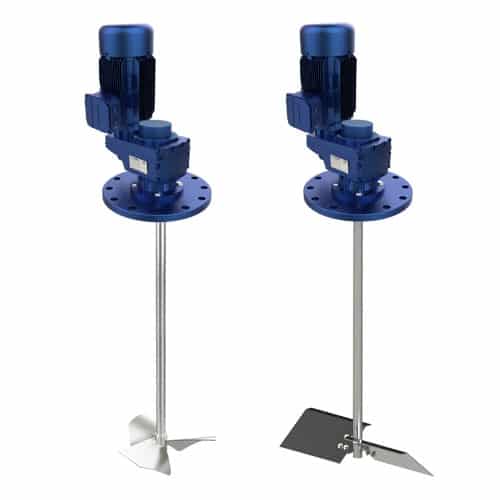
Vertical Agitators

Vertical Agitators: Suitable for top-mounted tank mixing, blending, homogenisation, and liquid circulation.

Horizontal Agitators suppliers

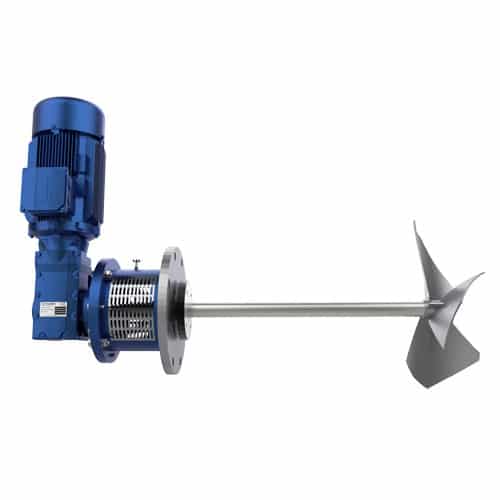
Horizontal Agitators

Designed for side-mounted installation in storage tanks and industrial vessels.

Submersible Agitators Suppliers and exporters

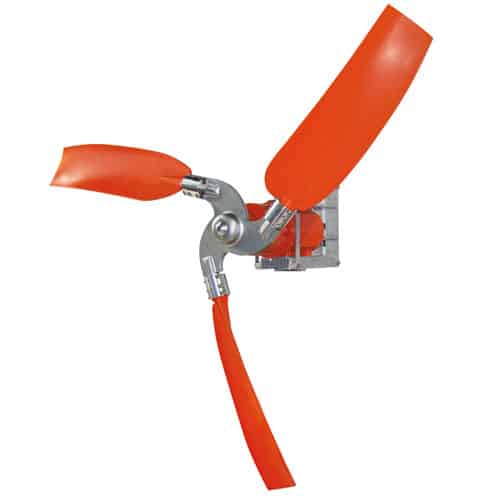
Submersible Agitators

Used for mixing liquids, wastewater, sludge, and slurry in tanks and treatment plants.

Tailor Made Agitators Supplier and Exporter

Tailor Made Agitators

Custom-engineered mixing solutions designed according to tank dimensions, liquid properties, process requirements, and industrial applications.

Stirred vessels

Industrial mixing and agitation play an essential role in a wide range of industrial processes. Industrial Tank Agitators are designed to achieve efficient mixing, blending, dispersion, homogenisation, suspension, and circulation of liquids, solids, gases, and other process materials. Depending on the application, agitators can be customised to meet specific process requirements and operating conditions.

Main Industrial Mixing Operations

Industrial agitators are used for various mixing operations, including:

  • Mixing of Miscible Liquids: Blending two or more liquids that can mix uniformly.

  • Gas Dispersion in Liquids: Dispersing gases into liquids in the form of small bubbles.

  • Mixing of Immiscible Liquids: Combining liquids that do not naturally mix.

  • Emulsion Formation: Dispersing one liquid into another to create fine droplets and stable emulsions.

  • Heat Transfer: Improving heat transfer between process liquids and heating or cooling coils.

  • Solid Suspension: Keeping solid particles suspended and evenly distributed throughout liquids.

  • Particle Size Reduction: Breaking down solid particles and reducing agglomeration.

  • Solid Dissolution: Facilitating the dissolution of solid materials into liquids.

  • Droplet Size Reduction: Reducing the size of liquid droplets and improving dispersion.

Some industrial processes require a combination of two or more mixing operations. These applications may need specially designed agitators to achieve the required mixing performance and process efficiency.

Types of agitators

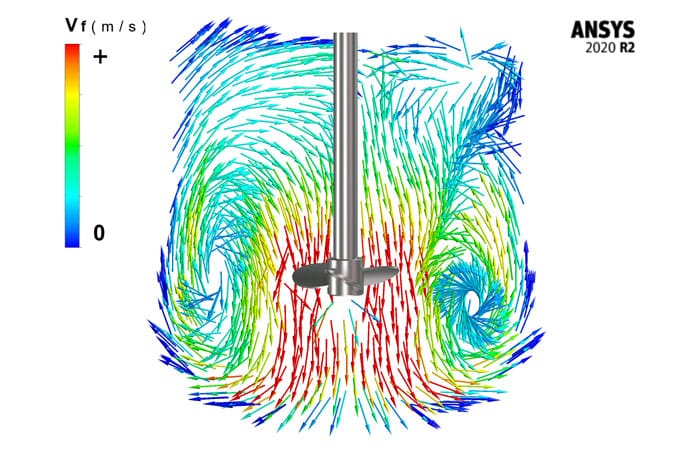
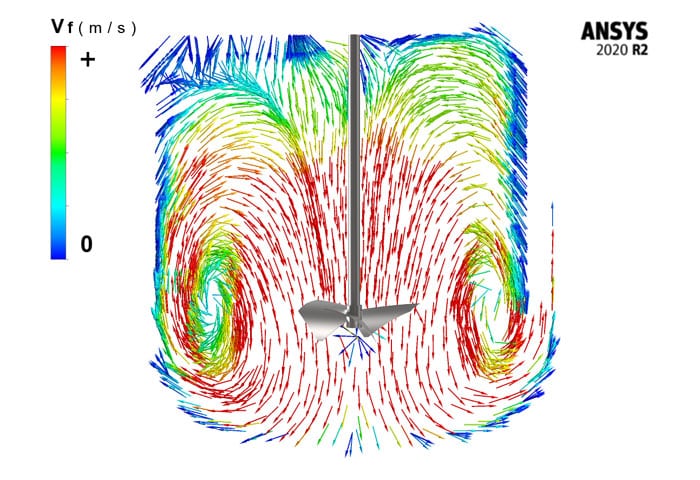
Tank agitators, depending on the main direction generated by their impeller inside the tank, can be axial, radial, or tangential flow. The type of flow will depend, in addition to the type of impeller, on the characteristics of the fluid and the geometry of the tank (with or without anti-vortex baffles):

Axial flow agitators

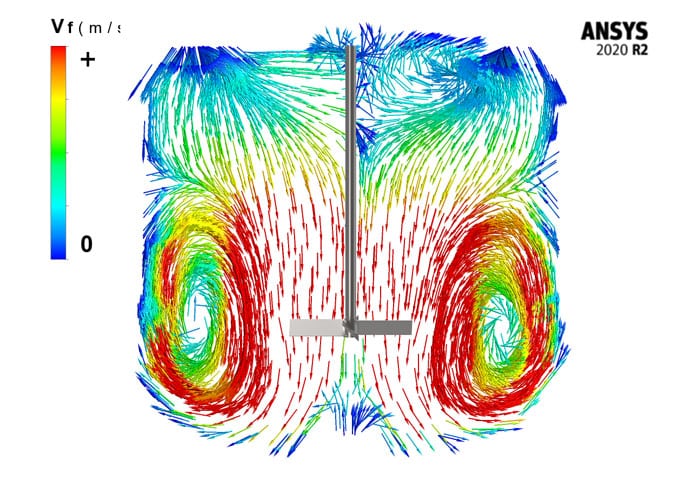
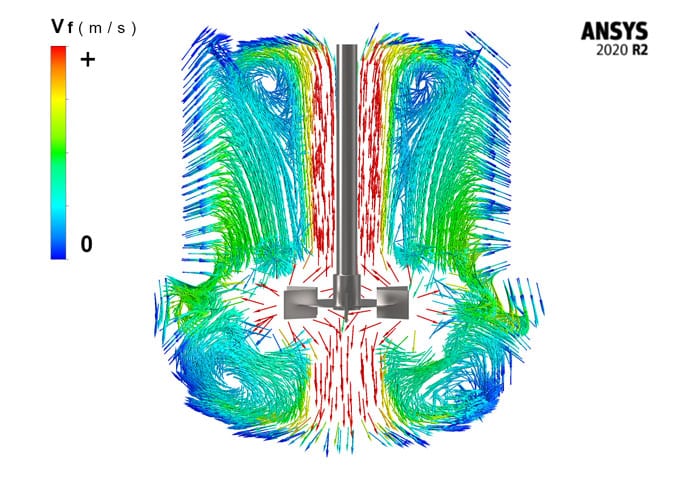
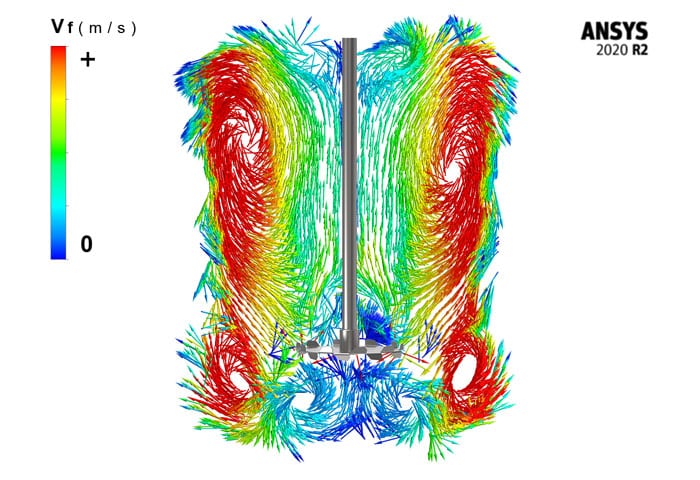
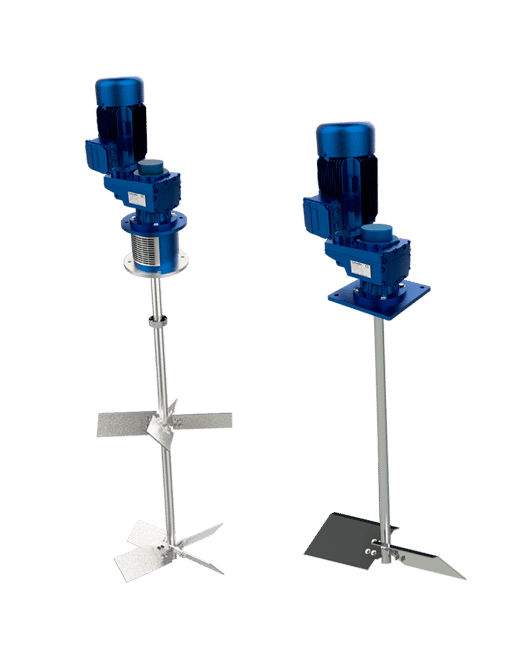
Axial flow agitators are those that generate currents parallel to the stirrer shaft. In this type of agitator, the most common impellers are marine propellers (VHS and VHD), profile-winged propellers (VPP, VPT, VPS), and inclined flat blade turbines (VTS, VTG).

Marine propellers (VHS, VHD)

This type of propeller works at very high turning speeds (1000 or 1500 rpm for small propellers or 750rpm for larger diameter propellers) generating medium turbulence. To avoid vortices, they should be placed in the off-center position. Used for mixing low viscosity liquids and in small volumes (2 or 3 m3) in homogenization, dissolution, reagent preparation, and neutralization applications.
 
Marine propellers Agitator

Impellers with high-performance profile. (VPP, VFR, VPT, VPS)

The high-performance profile provides a high pumping volume at relatively low speeds and with very little power consumption.

We have three types of profiles (type T, type T2, and type S) with different geometries and tilt angles. Depending on the type of regime and viscosity of the media to be mixed, our technical-commercial department will help you select the stirrer model with the most suitable profile. For volumes less than 5 m3 and homogenization of medium viscosity products, we have our standard VPP3 range with immediate delivery times.

For higher volumes, we perform the calculation and design of your agitator (model VFR, VPT, VPS) with power motors up to 45 Kw, reducers with high service factors, and specific systems depending on the working conditions.

Impellers with high-performance profile Agitator

Pitched blade turbines (VTS, VTG)

Turbine composed of 4 blades usually inclined 45º. Compared to the previous profile, its efficiency is low due to the simple shape of the blades, however, it is a versatile profile and very commonly used in various processes of the industry: homogenization, dissolution, neutralization, and reagent preparation. The main direction of the created flow is axial, but radial flow is also created.

 
Pitched blade turbines Agitator

Double flow Turbine (VTDF)

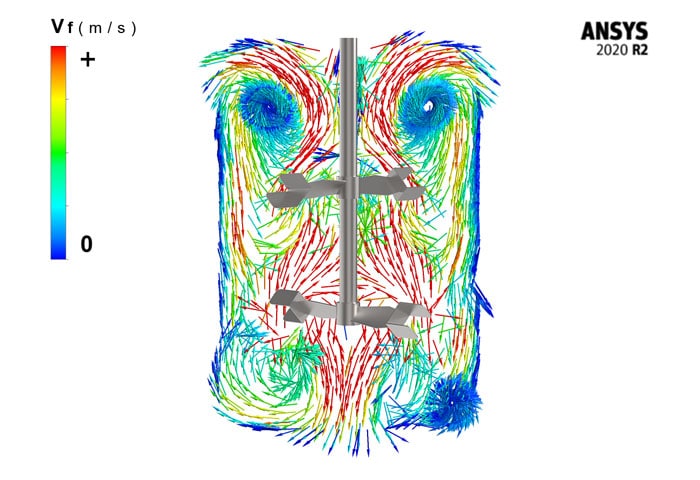
The design of this turbine is based on the arrangement of an internal shovel and another external shovel (usually u-shaped) on the same radial plane but at opposite angles. This arrangement originates axial current flows in the central and outer areas of the turbine in opposite directions. Normally two or several turbines are arranged along the shaft (depending on the height of the tank) out-phase each other 90º. The VTDF turbine is used in high viscosity product mixing processes.

Double flow Turbine Agitator

Helical Ribbon impeller (VHH)

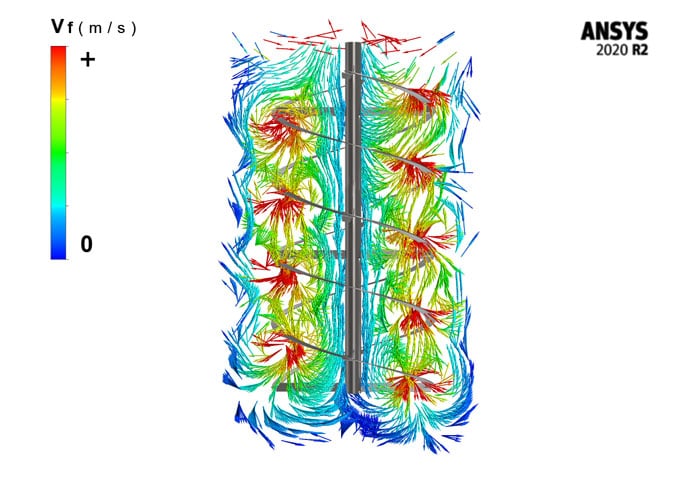
Helical ribbon impellers are best suited for highly viscous product mixtures (greater than 30,000 cps). They also stand out for their good efficiency in those processes where heat transfer is required.

With the helical ribbon impeller, an axial flow is obtained by the displacement effect on the laminar flow rate. They have a belt-shaped propeller and their joint to the shaft is done by crossbars which prevents the use of other elements inside the tank such as level controllers, samplers, etc. The distance between the tank wall and the tape should be very small so you should do without baffles in the tank.

 
Helical Ribbon impeller Agitator

Radial flow agitators

Radial flow impellers mainly generate a flow perpendicular to the stirrer shaft and when encountered with the vessel wall, it deviates up and down.

Flat Blade impeller with center disk (Rushton)

They consist of a disc in the horizontal plane to which several blades distributed symmetrically throughout its circumference are joined perpendicularly. Flat shovel disc turbines are mainly used for gasification applications.

 
Flat Blade impeller with center disk Agitator

Cowles Disc (VHDC)

Consisting of a circular disc with a large number of perpendicular teeth and evenly distributed throughout its circumference. They are suitable for mixing tasks where a very high shear effect (emulsification, solid deagglomeration, and wet grinding) is required. It is sometimes used in conjunction with an axial flow impeller to promote the circulation of more viscous fluids inside the tank.

Agitator Cowles Disc

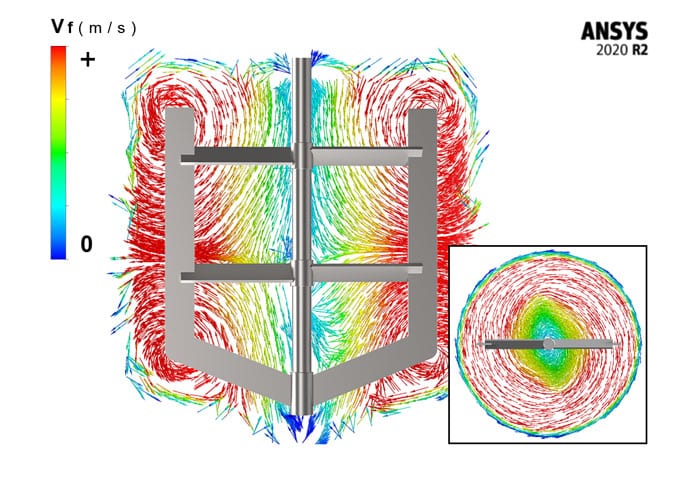
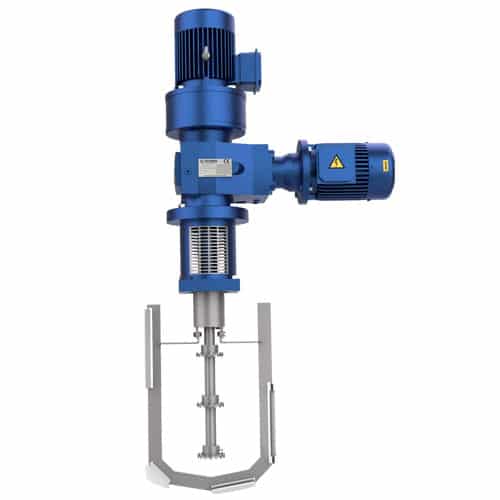
Anchor (VTRR)

The anchor usually consists of two parallel blades joined by another transverse at the bottom with the shape of the bottom of the tank.

The ratio between the diameter of the turbine and the diameter of the tank is 0.9-0.98, this means that the separation of the blades from the tank wall is very small. In this way, the material is prevented from adhesion to the walls, resulting in a good heat transfer with the walls.

They rotate at very low speed and despite the radial arrangement of the blades, they cause a tangential flow inside the tank. A variant of this type of turbine is the paddle type, which is used in large basins in flocculation processes or in those processes in which very low shear is required.

 
Radial flow agitators Anchor type